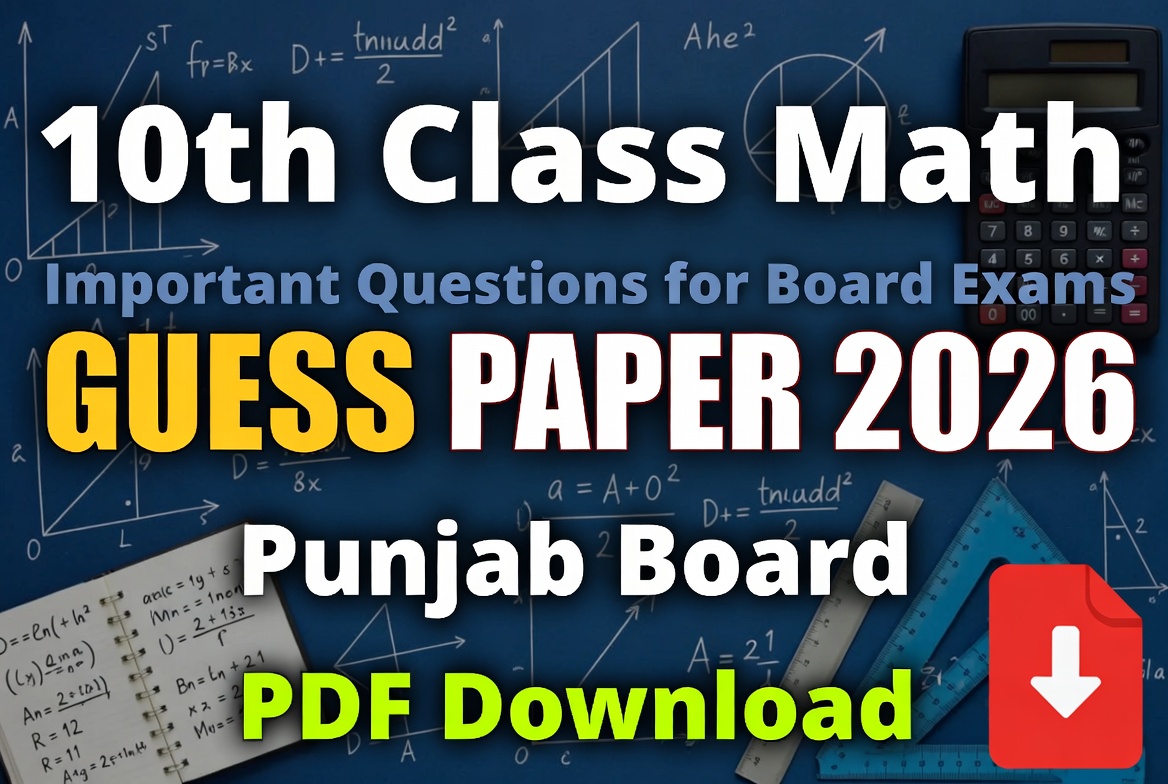
If you’re a 10th class student staring at your math book wondering where on earth do I even start you’re not alone. Math is one of those subjects that can feel like a mountain, especially when board exams are just around the corner.
That’s exactly why you’re here. This page gives you the complete 10th class Math guess paper for 2026, covering all Punjab Boards Lahore, Gujranwala, Faisalabad, Rawalpindi, Multan, Sargodha, Bahawalpur, DG Khan, and Sahiwal. Whether you’re in English medium or Urdu medium, this guide has you covered.
Let’s get into it.
What Is a Guess Paper and Why Does It Actually Help?
Before we dive into the actual questions, let me be honest with you — a guess paper is not a replacement for studying. It’s a smart revision tool.
Think of it this way: your math syllabus has around 13 chapters. Not all of them carry equal weight in the board exam. Some chapters have been appearing in papers for the last 5–7 years consistently. A good guess paper highlights exactly those chapters and question types, so you spend your limited time on what actually matters.
Used correctly, a guess paper can easily help you gain 10–15 extra marks just by focused practice on high-frequency topics.
10th Class Math Syllabus Overview 2026 (Punjab Board)
Before the guess paper, here’s a quick look at what chapters are in your 2026 syllabus:
| Chapter No. | Chapter Name |
|---|---|
| 1 | Quadratic Equations |
| 2 | Theory of Quadratic Equations |
| 3 | Variations |
| 4 | Partial Fractions |
| 5 | Sets and Functions |
| 6 | Basic Statistics |
| 7 | Introduction to Trigonometry |
| 8 | Projection of a Side of a Triangle |
| 9 | Chords of a Circle |
| 10 | Tangent to a Circle |
| 11 | Chords and Arcs |
| 12 | Angle in a Segment of a Circle |
| 13 | Practical Geometry — Circles |
10th Class Math Guess Paper 2026 — Important MCQs
MCQs carry 15 marks in the board paper. Below are the most important and repeated MCQ topics chapter by chapter.
Chapter 1 & 2 — Quadratic Equations
- Nature of roots using discriminant (b² – 4ac)
- Sum and product of roots
- Formation of quadratic equation when roots are given
- Solving quadratic equations by completing the square
Tip: MCQs from discriminant and sum/product of roots appear in almost every board paper. Do not skip these.
Chapter 3 — Variations
- Direct, inverse, and joint variation definitions
- Finding the constant of variation (k)
- Word problems based on variations
Chapter 4 — Partial Fractions
- Types of partial fractions (proper, improper)
- Cases when denominator has non-repeated, repeated linear factors
- Denominator with quadratic factors
Chapter 6 — Basic Statistics
- Mean, median, mode formulas
- Cumulative frequency
- Variance and standard deviation
Chapter 7 — Trigonometry
- Basic trigonometric ratios (sin, cos, tan)
- Trigonometric identities
- Values of trig ratios at standard angles (0°, 30°, 45°, 60°, 90°)
10th Class Math Guess Paper 2026 — Important Short Questions
Short questions carry marks in Section B of your paper. These are the most expected short questions based on past paper analysis (2019–2025):
From Quadratic Equations (Ch. 1–2)
- Solve the equation: x² – 5x + 6 = 0 by factorization
- Find the nature of roots of 2x² – 3x + 1 = 0
- If the roots of kx² + 4x + k = 0 are equal, find k
- Write the formula for sum and product of roots of ax² + bx + c = 0
- Find the quadratic equation whose roots are 3 and -5
From Variations (Ch. 3)
- If y varies directly as x and y = 12 when x = 4, find y when x = 7
- Define joint variation with an example
- If y is inversely proportional to x and y = 5 when x = 2, find x when y = 10
From Partial Fractions (Ch. 4)
- Resolve into partial fractions: (x + 3) / (x² – x – 2)
- What is the condition for proper fractions?
From Sets and Functions (Ch. 5)
- Define one-to-one function with example
- Find fog and gof if f(x) = 2x + 1 and g(x) = x²
- Differentiate between into and onto function
From Basic Statistics (Ch. 6)
- Find the mean of: 3, 7, 8, 11, 15, 20, 26
- Calculate the variance of 2, 4, 6, 8, 10
- Define cumulative frequency
From Trigonometry (Ch. 7)
- Prove that sin²θ + cos²θ = 1
- If tan θ = 4/3, find sin θ and cos θ
- Find the value of: sin 30° × cos 60° + sin 60° × cos 30°
From Geometry Chapters (Ch. 8–12)
- State the theorem: “The angle in a semicircle is a right angle”
- Define a tangent to a circle
- Write the theorem on equal chords and their distances from the centre
10th Class Math Guess Paper 2026 — Important Long Questions
Long questions are the biggest marks earner in your board paper. Here are the must-prepare long questions for 2026:
Exercise 1 & 2 — Quadratic Equations ⭐⭐⭐
- Solve by quadratic formula: 3x² – 10x + 3 = 0
- Word problem: The product of two consecutive positive integers is 90. Find the integers.
- Solve by completing the square: x² + 6x – 16 = 0
- Find roots: If the sum of roots is 7 and product is 12, write the equation
Exercise 3 — Variations ⭐⭐
- Joint variation problems (very common in past papers)
- Theorem: “If a/b = c/d then prove that (a+b)/(a-b) = (c+d)/(c-d)”
Exercise 4 — Partial Fractions ⭐⭐⭐
- Resolve: (3x² + 1) / [(x-1)(x+2)(x-3)]
- Resolve with repeated linear factors
Exercise 6 — Statistics ⭐⭐⭐
- Complete frequency distribution table and find mean using assumed mean method
- Calculate standard deviation from grouped data
- Draw cumulative frequency polygon (ogive)
Exercise 7 — Trigonometry ⭐⭐⭐
- Prove trigonometric identities (3–4 identities are usually asked)
- Most repeated: Prove that (1 + tan²θ) = sec²θ
- Find all trig ratios when one is given
Geometry Theorems ⭐⭐
These are must-memorize theorems for long questions:
- Perpendicular from the centre of a circle on a chord bisects it
- Two tangents drawn from an external point are equal in length
- The angle subtended by an arc at the centre is double the angle subtended at the remaining part of the circle
Chapter-wise Marks Weightage 2026 (Based on Pairing Scheme)
Understanding this will help you prioritize your time:
| Chapter | MCQs | Short Qs | Long Qs | Total Marks |
|---|---|---|---|---|
| Quadratic Equations (1-2) | 3 | 4 | 1 | ~16 |
| Variations (3) | 1 | 2 | 1 | ~8 |
| Partial Fractions (4) | 2 | 3 | 1 | ~12 |
| Sets & Functions (5) | 2 | 2 | — | ~6 |
| Basic Statistics (6) | 2 | 3 | 1 | ~12 |
| Trigonometry (7) | 2 | 3 | 1 | ~12 |
| Geometry (8–13) | 3 | 3 | 1 | ~14 |
Key takeaway: Chapters 1-2, 4, 6, and 7 together make up more than 60% of the paper. Focus on these first.
How to Use This Guess Paper the Smart Way
Here’s a simple 3-step method that actually works:
Step 1 — First, finish your textbook exercises.
Don’t jump straight to guess papers. Do at least one round of your NCERT/Punjab Board textbook first. Even a rough read helps.
Step 2 — Practice the important questions from this list.
Go chapter by chapter. Start with Ch. 1-2 (Quadratics), then jump to Ch. 7 (Trigonometry) and Ch. 6 (Statistics). These three alone can give you a solid base.
Step 3 — Attempt at least one past paper under exam conditions.
Set a timer for 3 hours. Sit down with a past paper and solve it like it’s the real exam. This is the single best way to build confidence and improve your speed.
Important Theorems to Memorize for 2026 Board Exam
Geometry theorems are often left for last — don’t make that mistake. Here are the ones most likely to appear:
- Theorem: A straight line drawn from the centre of a circle to bisect a chord (which is not a diameter) is perpendicular to the chord.
- Theorem: One and only one circle can pass through three non-collinear points.
- Theorem: Perpendicular from the centre of a circle on a chord bisects it.
- Theorem: If two arcs of a circle (or of congruent circles) are congruent, then the corresponding chords are equal.
- Theorem: The tangent to a circle at any point is perpendicular to the radius at the point of tangency.
Learn at least 3 of these properly. The proof + figure combination can earn you full marks.
Frequently Asked Questions (FAQs)
Q: Is this guess paper valid for all Punjab Boards in 2026?
Yes. The 10th class Math syllabus is the same for all Punjab Boards — Lahore, Gujranwala, Faisalabad, Rawalpindi, Multan, Sahiwal, Sargodha, Bahawalpur, and DG Khan. This guess paper covers all of them.
Q: Is this guess paper for Urdu medium and English medium both?
Yes, the chapters and topics are the same in both mediums. The only difference is the language of the question paper.
Q: How reliable are guess papers for scoring good marks?
Guess papers are based on years of past paper analysis and topic frequency data. While nothing is 100% guaranteed, students who practice from a well-prepared guess paper consistently score better in board exams.
Q: When should I start practicing from this guess paper?
Ideally, start 3–4 weeks before your board exam. Give 1–2 days per chapter and make sure to revise at least twice.
Q: Are these questions enough to get 80+ marks in Math?
If you prepare all the questions listed in this guess paper thoroughly — including MCQs, short questions, and long questions scoring 75–90+ marks is very realistic.
Final Word You’ve Got This
Math feels hard until it suddenly doesn’t. The turning point usually comes when you stop panicking and start practicing chapter by chapter. Use this guess paper as your roadmap, not a shortcut.
Revise your formulas every morning. Solve at least 5–7 long questions before your exam. And don’t leave geometry theorems till the last day.
You’ve got this. All the best for your 2026 board exams! 🎯